
Give the reference feature an address
La Malfa and colleagues introduced identifying features on experimental masters that also appeared in their molded samples. A purchase drawing can use that principle even when the design has no special marker. Choose a visible edge, opening or asymmetric corner already present. Label it on the overview and give the closest feature an address, such as A1. Keep the uncropped overview with the address visible whenever you send a close-up to a reviewer.
La Malfa et al. (2025) · Reference features and coded arrays in mold replication
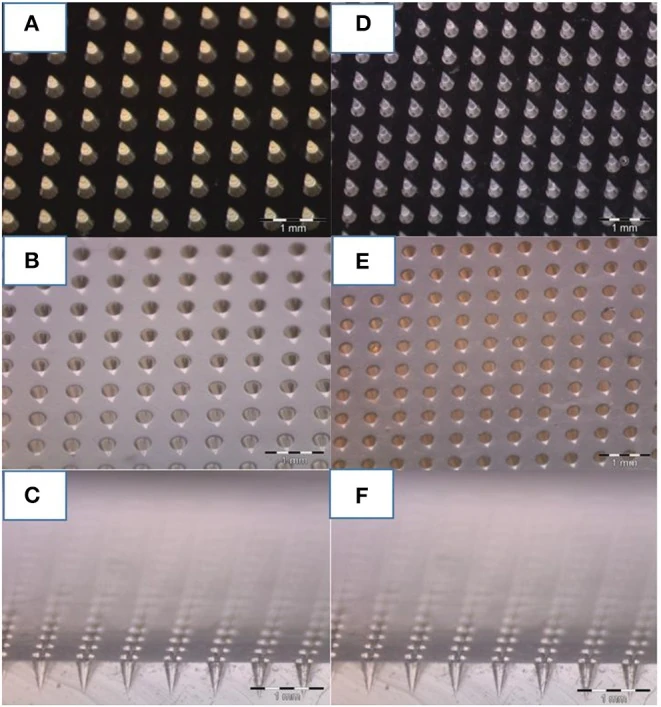
Image credits
Mario Battisti, Raffaele Vecchione, Costantino Casale, Fabrizio A Pennacchio, Vincenzo Lettera, Rezvan Jamaledin, Martina Profeta, Concetta Di Natale, Giorgia Imparato, Francesco Urciuolo and Paolo Antonio Netti · Image source · CC BY 4.0 · Original figure proportions and markings retained; converted to WebP.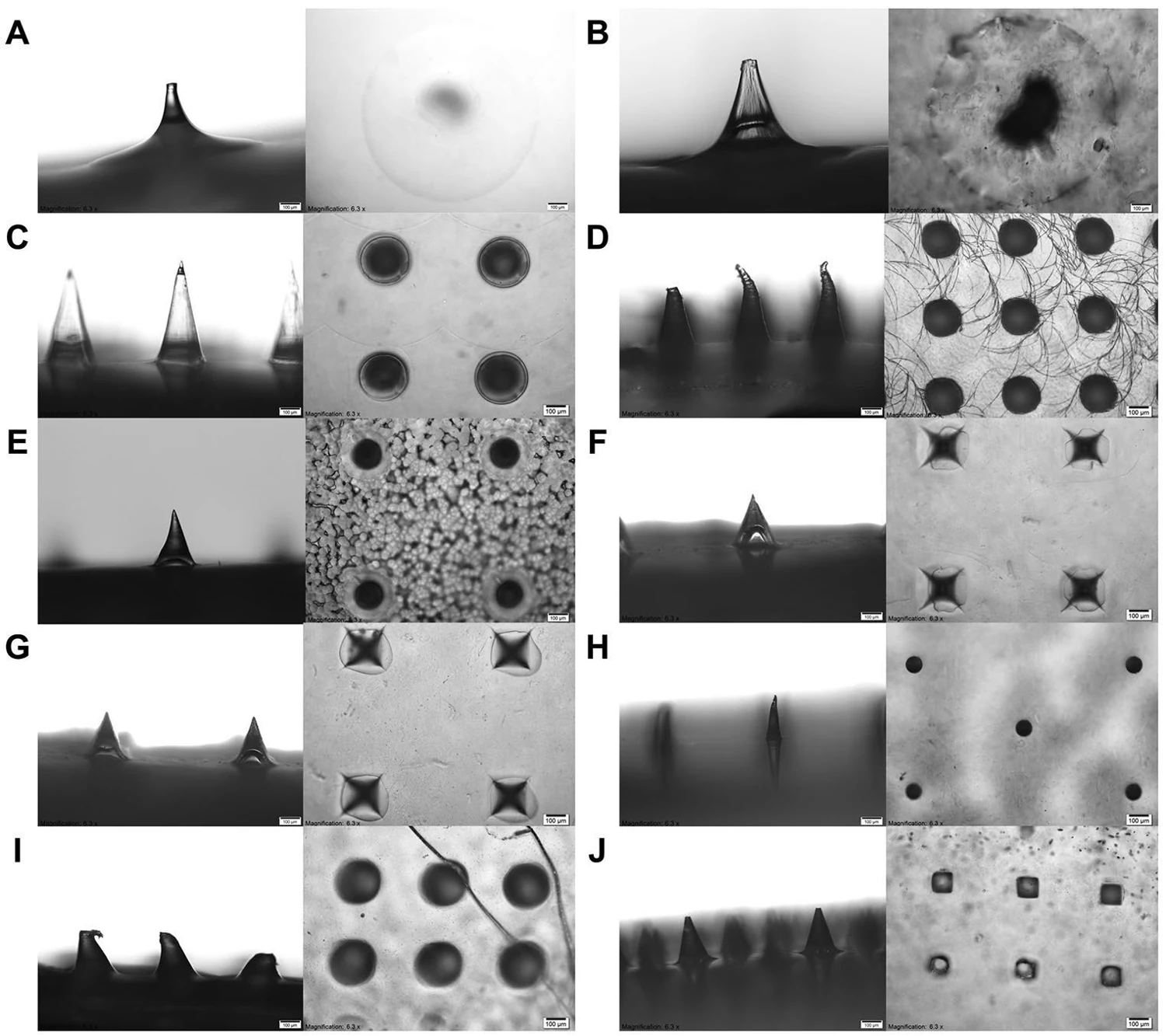
Image credits
Jing Yi Lee, Shi Hui Dong, Keng Wooi Ng and Choon Fu Goh · Image source · CC BY 4.0 · Original figure proportions and markings retained; converted to WebP.Show the face presented to the camera
Label each view with the object and the face being viewed. A person looking into a cavity and another looking at its positive replica may describe opposite sides as “left.” A practical test is to ask both reviewers to point to A1 and the next position along the row. If they point to different neighbors, annotate the direction on the images before comparing measurements or circulating a defect report.
Faraji Rad et al. (2017) · Three-dimensional comparison of master, mold and replica
Make a disputed position easy to find again
Suppose a supplier circles one feature near a corner of a square array. Ask for the full field with that corner marked, followed by the detail bearing the same field and position name. Record any rotation or mirroring used for display. With those three details, a colleague can locate the physical position on a returned sample and tell whether a later photo documents the same concern or a different corner.
La Malfa et al. (2025) · Reference features and coded arrays in mold replication
Prepare your inquiry
A feature address, face label and uncropped overview let two reviewers locate the same position independently.