
Identify the recessed part
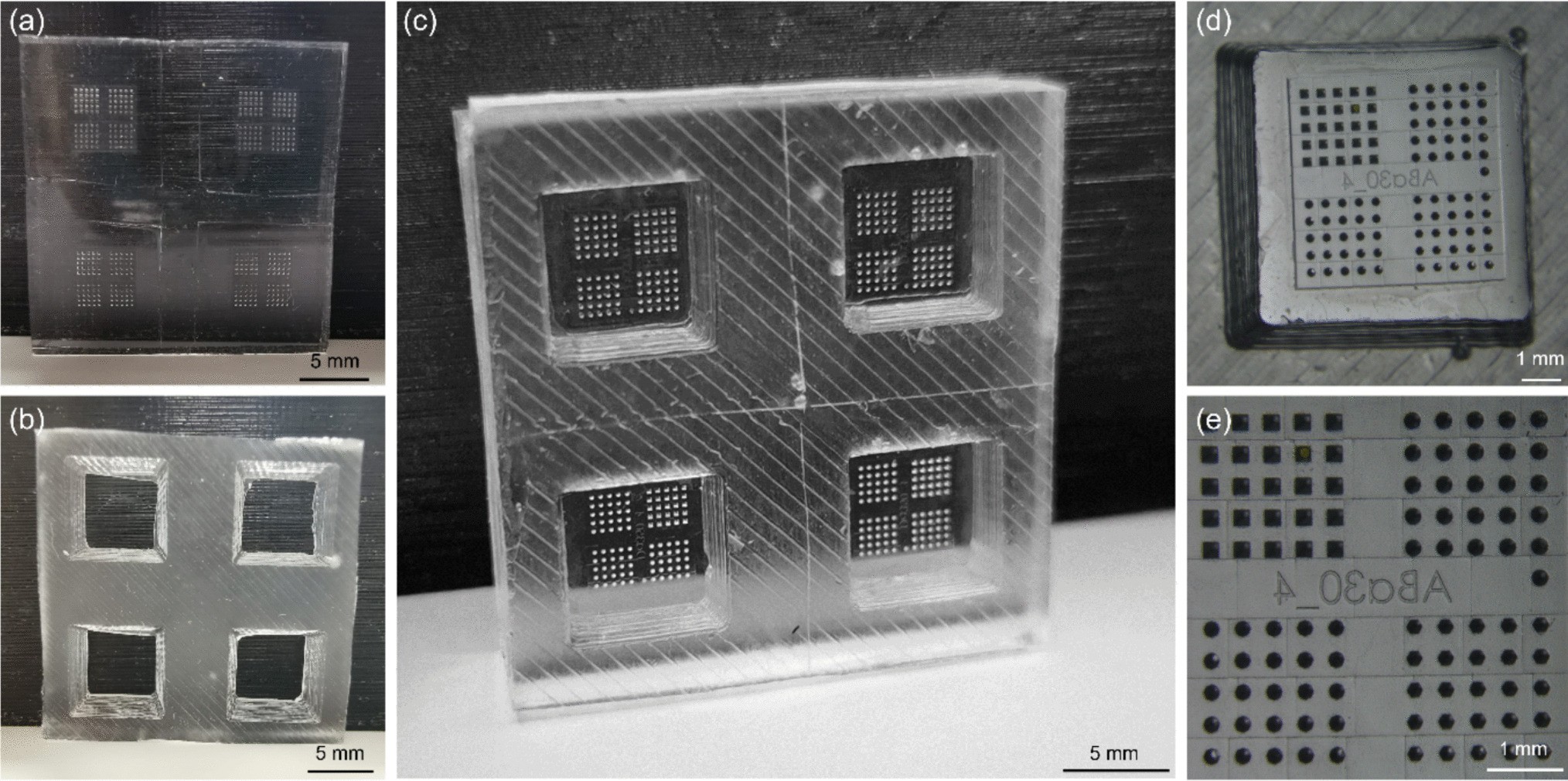
On a negative template the working face contains cavities. A photograph of a translucent template sometimes shows the pattern through its back, reversing the apparent orientation. Ask the supplier to label the side being shown and mark one corner as a reference.
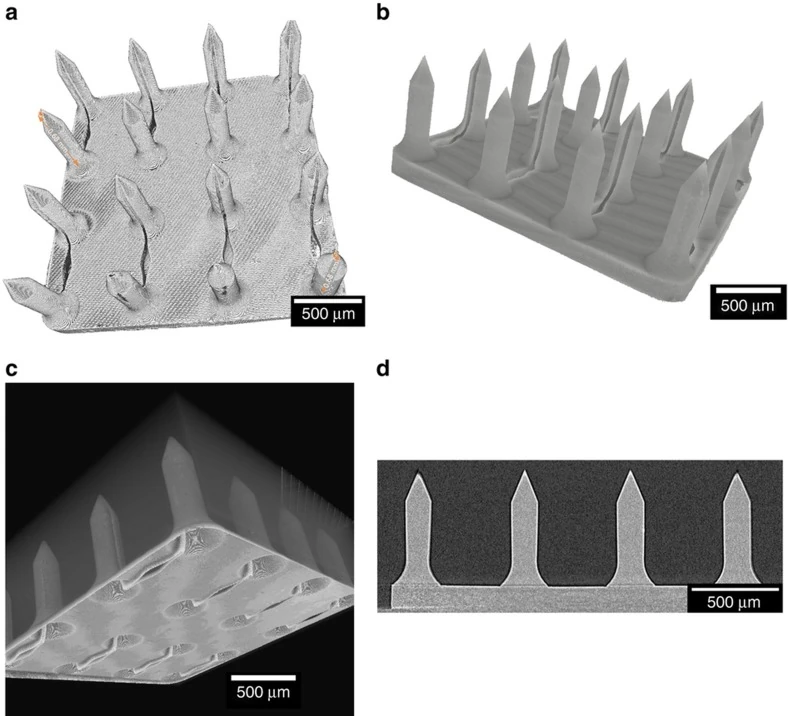
Image credits
Zahra Faraji Rad, Robert E Nordon, Carl J Anthony, Lynne Bilston, Philip D Prewett, Ji-Youn Arns, Christoph H Arns, Liangchi Zhang and Graham J Davies · Image source · CC BY 4.0 · Original figure proportions and markings retained; converted to WebP.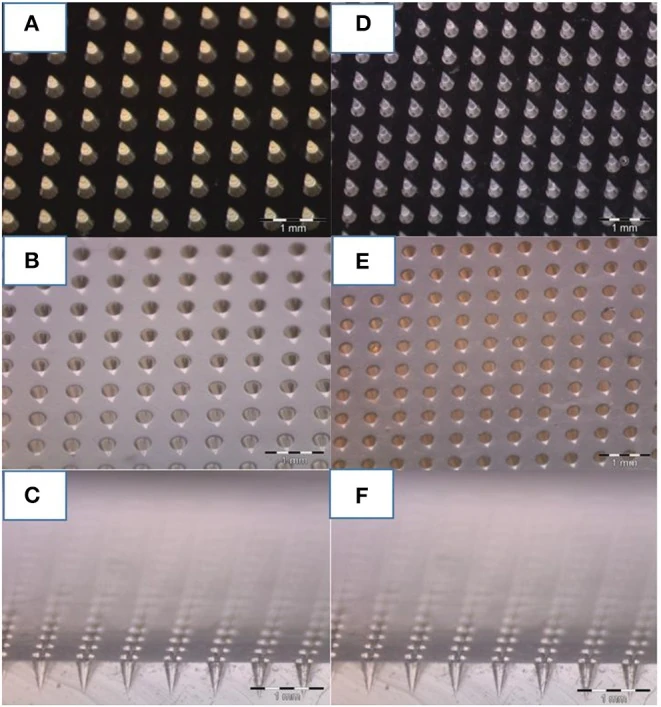
Image credits
Mario Battisti, Raffaele Vecchione, Costantino Casale, Fabrizio A Pennacchio, Vincenzo Lettera, Rezvan Jamaledin, Martina Profeta, Concetta Di Natale, Giorgia Imparato, Francesco Urciuolo and Paolo Antonio Netti · Image source · CC BY 4.0 · Original figure proportions and markings retained; converted to WebP.Check the area around the cavities
A sample with an attractive pattern may still have the wrong outer footprint for the buyer's holder. Check the overall outline, working area, edge clearance and orientation features as separate items. If a template arrives mounted, identify whether its dimensional drawing includes the mount.
Compare a paired set
To review correspondence, request a drawing or photograph of the approved master together with the matching cavity template. Record both identifiers. State explicitly if the request is for one empty template, a pair of tools or sample patches made for evaluation.
What does an apparently empty cavity actually show?
Evens and colleagues published cross-sections of an empty cavity and a cavity containing a broken feature. An overhead photo can leave that distinction unresolved. For a disputed spot, identify its row, column and sample, then ask for evidence that shows the interior at that location. Keep the suspected cause separate from the observation until both parties can review it. This lets a supplier propose an appropriate follow-up without labelling every unusual silhouette as damage.
Evens et al. (2022) · Cavity inspection and feature uniformity in molded arrays
Prepare your inquiry
Name the recessed deliverable in the purchase request.