
Identify what arrived in the shipment
Start the file with the purchase line, drawing revision, physical tool identifier and any molded sample supplied with it. A master, a negative mold and a sample made using that mold can have separate identities. Faraji Rad and colleagues measured these three stages separately in their research. A buyer can adopt this distinction by labelling the evidence for each item and recording which physical pieces the receiving team actually has.
Faraji Rad et al. (2017) · Three-dimensional comparison of master, mold and replica
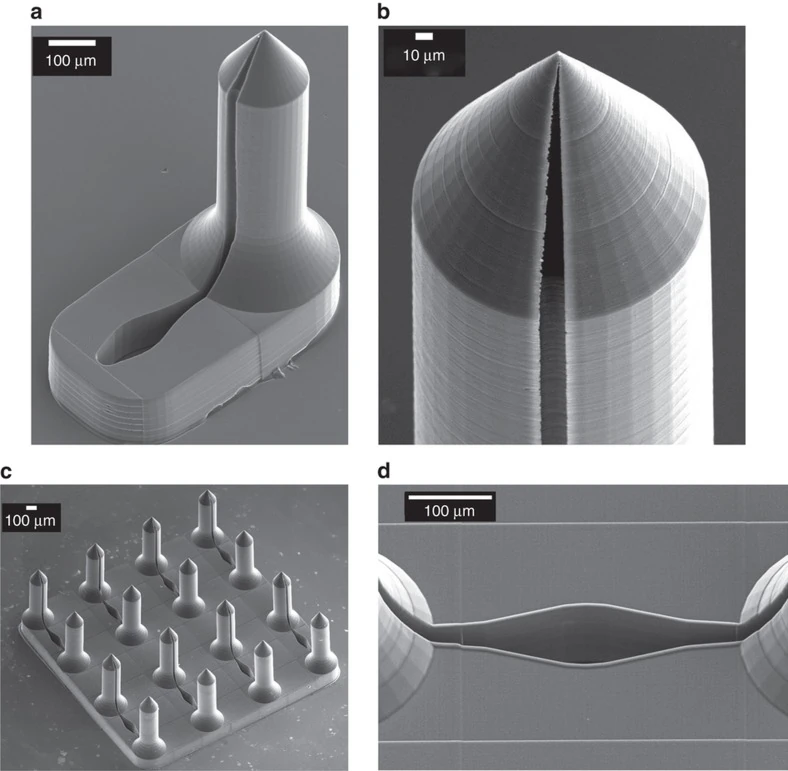
Image credits
Zahra Faraji Rad, Robert E Nordon, Carl J Anthony, Lynne Bilston, Philip D Prewett, Ji-Youn Arns, Christoph H Arns, Liangchi Zhang and Graham J Davies · Image source · CC BY 4.0 · Original figure proportions and markings retained; converted to WebP.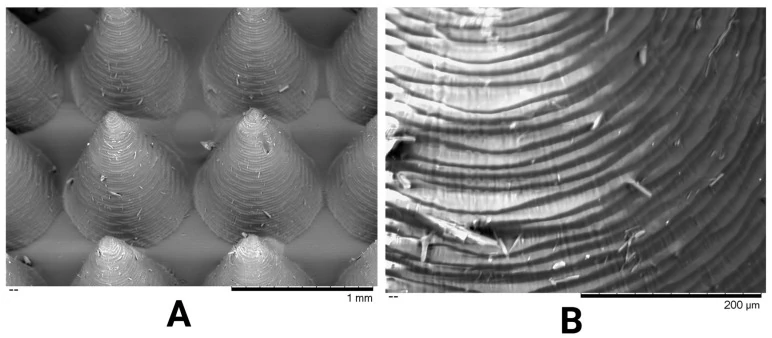
Image credits
Rutuja N. Meshram and Dimitrios A. Lamprou · Image source · CC BY 4.0 · Original figure proportions and markings retained; converted to WebP.Connect each acceptance question to one result
Take one drawing feature, such as the base width, and follow it through the file. Can a second reviewer find its nominal value, reported measurement, units, reference image and physical position? Repeat that check for the other agreed features. Tamez-Tamez and colleagues reported several geometric dimensions on their research samples. Their separation of dimensions illustrates why an aggregate statement such as “profile checked” gives a buyer little basis for accepting a specified width.
Tamez-Tamez et al. (2023) · Dimensional and surface metrology of square pyramidal features
Record open questions before releasing the next order
Imagine that the first article has a complete dimension table but no label connecting the photographed sample to the delivered tool. Record the missing link and ask the supplier to identify the corresponding sample. Keep any decision on the verified dimensions visible while the identity question is resolved. Gülçür and colleagues compared results across molding trials. For later reorders, retaining the original sample and run identifiers makes the first article a usable reference.
Gülçür et al. (2023) · Characterising replication across molding trials
Prepare your inquiry
A receiving reviewer should be able to trace each agreed characteristic to a physical item and its supporting result.